
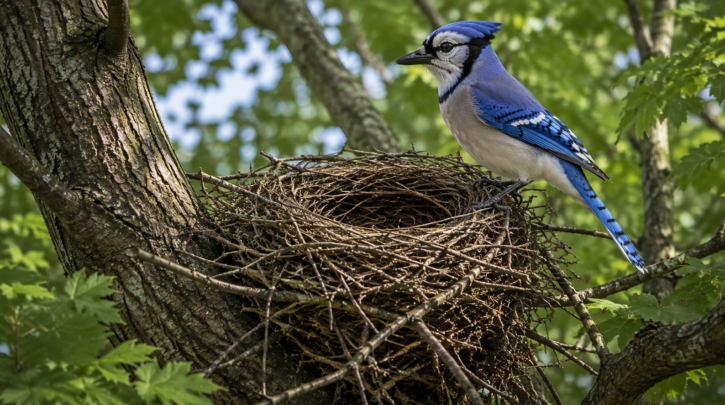

Unlike several of the cavity-dependent species, Blue Jays build a completely open nest — a sturdy cup of twigs and bark set well up in a tree, with no cavity, no excavation, and no nest box involved at all.
Basic Construction
The nest is a fairly substantial cup built from twigs and strips of bark, sometimes incorporating a bit of mud, and lined with softer material such as rootlets and moss. Jays are also opportunistic about incorporating human-made material when it’s available, occasionally weaving in string, paper, or cloth alongside the natural components.
Both Parents Build Together
Unlike several species where the female handles most or all construction, Blue Jay nest building is more of a shared effort, with both members of a pair typically participating in gathering material and shaping the nest cup.
Nest Placement
Nests are typically built ten to twenty-five feet up in a tree or large shrub, well above ground level, though exact height varies by habitat and available tree structure. This placement offers meaningfully better protection from ground-based predators than a low shrub nest would.
How Long Construction Takes
Building a complete nest typically takes one to two weeks, a reasonably substantial investment of time compared to the faster open-cup construction seen in some smaller songbirds , reflecting the larger, sturdier structure a bird this size actually needs.
Aggressive Nest Defense
Jays are known for aggressively defending an active nest against intruders, including loud alarm screaming and direct diving passes at anything — a cat, a hawk, or even a person — that gets too close. This defensive intensity is consistent with the bold, vocal personality covered throughout this site.
A Blue Jay defending an active nest doesn’t rely on staying hidden the way many smaller songbirds do — it relies on being loud, visible, and genuinely intimidating to anything that gets too close.
Nest Reuse
Jays typically build a fresh nest each year rather than reusing an old structure directly, similar to the pattern seen in several other open-nesting species, though a pair may occasionally reuse a general nest site even while rebuilding the actual structure.
What Comes Next
Once the nest cup is complete, egg laying typically follows within days. See our eggs guide for clutch size and incubation, and our baby blue jays guide for what happens after hatching.
Curious how some of Blue Jay’s relatives handle nesting completely differently? See our cooperative breeding guide for the genuinely unusual social structure some jay species rely on.
A Contrast Worth Noting
An open, exposed stick nest built entirely in the open canopy represents a real departure from the cavity-focused nesting strategies — no excavation, no reused woodpecker hole, no nest box, just a sturdy structure built from scratch in plain view and defended aggressively rather than hidden.
Nest Placement Within the Tree
Beyond overall height, jays generally favor a well-concealed position within the canopy rather than an exposed outer branch, using surrounding foliage for some visual cover even though the nest itself sits fully in the open rather than inside any enclosed structure.
Material Choices Vary by Habitat
Exact material composition shifts somewhat depending on what’s locally available — a jay nesting in suburban habitat with easy access to string or paper scraps may incorporate more human-made material than one nesting deeper in undisturbed forest, where natural twigs, bark, and moss make up virtually the entire structure.
Comparing Nest Types With Other Backyard Birds
A jay’s open stick nest sits closer in general concept to an oriole’s hanging pouch or a finch’s open cup than to any of the cavity strategies, though built at considerably larger scale and defended far more aggressively than either of those comparably exposed nest types found across the wider songbird world, given how much stronger, larger, and more forceful a jay actually is compared to a typical finch, chickadee, or oriole.
A Nest Built for Confrontation, Not Concealment
Where many open-nesting songbirds rely primarily on camouflage and quiet stillness to avoid drawing predator attention, Blue Jay leans instead on active, aggressive confrontation once a threat is detected — a genuinely different defensive philosophy that reflects the species’ larger size, stronger bill, and bolder overall temperament.