
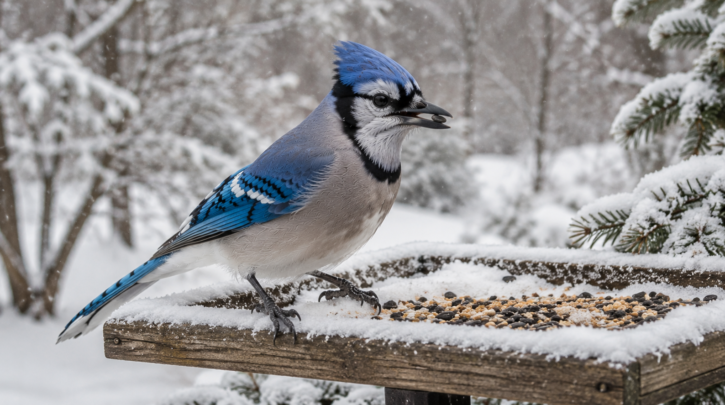

Winter is largely a resident season for most jay species, supported directly by the fall caching effort covered in our fall guide — and, for Canada Jay specifically, winter is when next year’s breeding season effectively already begins.
Drawing on Fall Caches
Cached acorns and other nuts from fall become an important supplemental food source through winter, retrieved using genuine spatial memory rather than random searching. Not every cache gets found again, which is exactly the mechanism behind the oak dispersal story covered in our oak forest guide.
Steady Feeder Activity
Winter typically brings the heaviest feeder demand of the year, since natural food is scarcer and cached food alone may not cover every day’s energy needs. See our peanut and nut feeder guide for keeping a station stocked through the coldest stretches.
Managing Feeder Access in Winter
Because jays can dominate a shared feeding station, winter is also when the balance covered in our jay-proof feeder guide matters most, given how much more competitive feeder access can become once natural food is at its scarcest for every visiting species.
Canada Jay: An Extraordinarily Early Start
While every other species on this list is simply surviving winter, Canada Jay is already building toward the following breeding season — incubation for this species begins in late winter, in temperatures well below freezing, supported by dense insulating feathers and an insulated nest structure covered in our migration guide.
Why This Timing Works for Canada Jay
Beginning so early lets Canada Jay chicks fledge and gain independence before the short boreal summer’s food resources become stretched thin by other competing demands, a genuinely different survival strategy than any other species.
Pinyon Jay: Still Tracking the Cone Crop
Pinyon Jay flocks continue shifting based on pinyon pine cone availability through winter, meaning local presence in a given area can remain genuinely unpredictable right through the coldest months, similar in spirit to the winter finch irruptions.
Ready for whatever winter brings? Revisit our feeder guide and birdbath guide to make sure your setup can handle the season’s heaviest demand.
Looking Back at a Full Year
From spring construction through summer’s demanding brood, fall’s ecologically significant caching, and winter’s reliance on memory and stored food, the jay year is a genuinely complete cycle — one that, for Canada Jay specifically, never really pauses at all before the next breeding season quietly begins.
A Reasonable Winter Checklist
- Keep peanut and nut feeders stocked through the coldest stretches
- Watch for signs of local Pinyon Jay movement if you’re within that species’ range
- Maintain a jay-proof feeder if smaller birds need protected access during peak winter demand
- Keep an eye out for early Canada Jay nesting activity if you’re within its boreal range
A Fitting Close to a Genuinely Varied Family
Between an unresolved partial migrant, three straightforward residents drawing on fall caches, a nomadic pine-seed specialist, and a species already raising chicks in the coldest part of the year, winter captures just how differently five closely related jay species have each solved the same basic challenge of getting through the year.
A Genuinely Satisfying Family to Follow Year-Round
Few backyard bird families reward continuous, year-round attention as richly as jays do — every season brings something genuinely worth watching, whether it’s a caching flight, an aggressive nest defense, or a Canada Jay quietly incubating through weather most other birds simply couldn’t survive.
A Season to Reflect on the Whole Family
Winter is a reasonable point in the year to look back across everything covered on this site — identification, diet, nesting, migration, and the genuinely significant ecological role jays play in oak forest spread — and appreciate just how much depth exists behind a bird many people dismiss as simply loud and common.
Looking Ahead to Spring
As winter progresses, Blue Jay and its more southerly relatives begin edging toward the territorial and pairing behavior covered in our spring guide, closing the loop on a genuinely full, eventful year of activity across this entire fascinating family.
Final Thoughts
Whatever season brought you to this guide, the same underlying story holds true throughout: jays are bold, intelligent, occasionally misunderstood, and genuinely worth the attention this entire site has devoted to them across every single one of its guides, from identification all the way through to winter survival.
Thank you for spending this much time with jays — a genuinely underrated family, hiding real intelligence and real ecological significance behind a loud, familiar, sometimes overlooked exterior.