
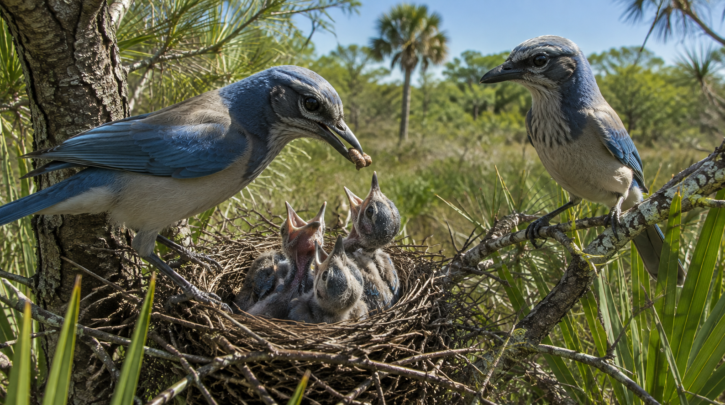

Blue Jay itself is a simple pair-nesting species, but several of its close relatives rely on a genuinely different social structure — cooperative breeding, where grown offspring stick around to help raise their parents’ next brood rather than striking out on their own.
Blue Jay: A Simple Pair-Nesting Species
Across its range, Blue Jay nests as a simple pair without helpers, following the more familiar two-parent structure covered in our nest guide. This makes the cooperative systems found elsewhere in the jay family even more striking by comparison.
Florida Scrub-Jay: One of Ornithology’s Best-Studied Cooperative Breeders
Florida Scrub-Jay, a range-restricted relative found only in Florida’s scrub habitat, is one of the most thoroughly studied cooperative breeders in all of ornithology. Young from a previous brood, known as helpers, often remain with their parents for a year or more, assisting with feeding chicks and defending territory before eventually establishing a territory of their own.
Why Helpers Stick Around
Suitable scrub-jay territory is limited and difficult to establish independently, making it advantageous for a young bird to remain with its parents, gain experience, and improve its own eventual chances of successful breeding rather than risk striking out immediately into already-saturated habitat.
Mexican Jay: A Similar Extended-Family Pattern
Mexican Jay shows a broadly similar cooperative tendency, with extended family groups contributing to raising subsequent broods rather than each pair operating entirely independently.
Pinyon Jay: Colonial Rather Than Cooperative
Pinyon Jay takes a different, though still highly social, approach — large colonial nesting groups rather than a direct helper system, with birds benefiting from group vigilance and coordinated foraging even without individual offspring specifically staying to assist their own parents.
Canada Jay: Sibling Rivalry Within the Family Group
Canada Jay shows yet another pattern — family groups persist after fledging, but siblings compete with each other for the advantageous position of remaining with the parents longest, with a dominant sibling typically staying while subordinate siblings are eventually displaced or leave earlier. This competitive dynamic is genuinely different from the more cooperative helper systems seen in Florida Scrub-Jay.
Within a single family of birds, social structure ranges from Blue Jay’s simple pair nesting to Florida Scrub-Jay’s genuine multi-year helper system — a spread of social complexity rarely seen within one closely related group.
Why Jays Show This Much Social Variation
This spread of social strategies likely reflects how differently habitat availability and territory saturation shape the payoff of staying versus leaving across different jay species and the specific ecological pressures each one faces.
Curious what a typical, non-cooperative jay brood actually looks like day to day? See our baby blue jays guide for the standard Blue Jay pattern most backyard hosts will actually observe.
Conservation Relevance
Florida Scrub-Jay’s cooperative breeding system is closely tied to its conservation status — because the species depends on a very specific, limited scrub habitat and a social structure built around territory scarcity, habitat loss has a particularly direct and well-documented impact on the species’ ability to maintain functioning family groups.
Why This Species Is So Well Studied
Decades of long-term, individually tracked research on Florida Scrub-Jay populations have made it one of the most detailed case studies of cooperative breeding in any bird species worldwide, offering insight that extends well beyond jays into how cooperative breeding evolves and persists in birds generally.
A Genuinely Instructive Comparison
Seeing this much social variation within one closely related family — simple pairs, multi-year helpers, colonial nesting, and sibling competition — makes jays a particularly useful case study for understanding how flexible avian social structure can be even among species that share a very recent common ancestor.
A Reminder About Assuming Family-Wide Behavior
It’s tempting to generalize a single behavior pattern across an entire bird family, but jays are a genuine counterexample — five closely related species handle the same basic challenge of raising young in five meaningfully different ways, each shaped by its own specific habitat and ecological pressures.
What This Means for a Backyard Host
Most backyard hosts across the Blue Jay’s range will only ever observe the simple, non-cooperative pair-nesting pattern covered in our nest guide, since Florida Scrub-Jay’s cooperative system is confined to a genuinely narrow, specific habitat well outside most typical yards.
A Family Worth Learning About Even Without Direct Observation
Even without ever seeing a cooperative jay family firsthand, understanding that this variation exists within the broader family adds real context to just how flexible and behaviorally diverse jays are as a group, well beyond whatever single species happens to visit a given backyard.