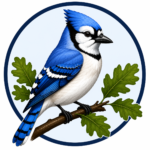
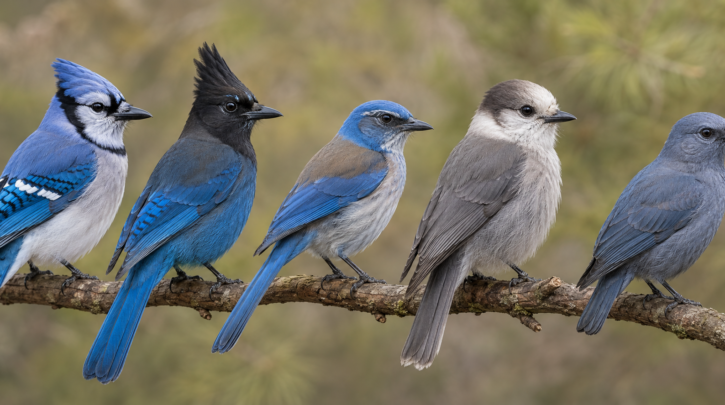

Five jay species cover most of North America between them, and while they’re all unmistakably corvids — bold, vocal, intelligent — their plumage varies dramatically from one species to the next, from a crested blue-and-white Blue Jay to a soft, crestless gray Canada Jay.
Blue Jay
- Bright blue upperparts, whitish-gray underparts, a prominent blue crest
- A black necklace-like band across the throat and around the head
- Black barring and white markings on the wings and tail
- Range: eastern and central North America, into southern Canada
Steller’s Jay
- A close relative of Blue Jay in the same genus, but visually quite different
- Black head and crest, dark blackish-blue body, with none of the white markings a Blue Jay shows
- Range: coniferous forest across the western mountains, from Alaska down through California and the Rockies
California Scrub-Jay
- No crest at all — a smooth-headed jay, unlike the first two species
- Blue head, wings, and tail with a gray-brown back and a pale underside crossed by a faint grayish-blue necklace
- Range: Pacific coast oak woodland, chaparral, and scrub, common in yards across much of California and the Pacific Northwest
Canada Jay
- Soft, fluffy gray plumage with a whitish face and forehead and a darker cap toward the back of the head
- No crest, and a noticeably rounder, softer overall silhouette than the crested species
- Range: boreal forest across Canada and Alaska, extending into some northern US mountain ranges
Pinyon Jay
- Uniform dull blue-gray over the entire body, no crest, with a shorter tail and more crow-like proportions than the other four species
- A stubby, pointed bill specifically adapted for extracting seeds from pinyon pine cones
- Range: pinyon-juniper woodland across the Southwest and Great Basin
The Crest Test
Crest presence and shape does a lot of the identification work fast: Blue Jay and Steller’s Jay both show a prominent crest, while California Scrub-Jay, Canada Jay, and Pinyon Jay are all crestless. Combined with range, this narrows most sightings down immediately.
A Biology Note: The Blue Isn’t Really Blue
Blue Jay and Steller’s Jay owe their blue color to structural coloration rather than blue pigment — microscopic structures in the feather barbs scatter light in a way that reads as blue to the eye, similar to how a blue sky isn’t caused by a blue substance in the atmosphere. A crushed Blue Jay feather actually turns brown, since crushing destroys the light-scattering structure and reveals the feather’s underlying pigment, which was never blue to begin with.
A Blue Jay’s feather isn’t actually pigmented blue at all — the color is an optical effect of feather structure, and a crushed feather reveals the plain brown pigment underneath.
Sexing Jays: A Note Before You Try
All five species are essentially monomorphic — males and females look alike in the field, a pattern covered in full in our male vs. female guide. Don’t expect a reliable visual field mark for sex the way you might with a bluebird or an oriole.
What to Do Once You’ve Made an ID
Identified a jay caching something in your yard? See our oak forest guide for the genuinely significant ecological role this behavior plays, and our calls and mimicry guide if you hear an unusually convincing hawk call nearby.
Not sure which species is visiting your yard? Our binoculars buying guide covers the optics that make crest shape and subtle color differences easy to see at typical backyard distances.
Range Overlap
Steller’s Jay and Pinyon Jay overlap across parts of the interior West, generally separated by habitat — Steller’s Jay sticks to denser coniferous forest, while Pinyon Jay favors more open pinyon-juniper woodland. Blue Jay and Steller’s Jay ranges meet only in a narrow band through the Great Plains, where actual overlap and any hybridization remains far less studied than the well-documented hybrid zones covered elsewhere in this network.
Size and Shape as Secondary Clues
Beyond crest and color, overall proportions offer useful backup clues. Pinyon Jay has a noticeably shorter, more crow-like tail relative to its body than the other four species, while Canada Jay’s fluffy, rounded silhouette stands apart from the sleeker profile of the crested Blue Jay and Steller’s Jay.
Juveniles
Juvenile jays across all five species tend to look like duller, slightly grayer versions of the adult pattern rather than a dramatically different plumage stage, gradually acquiring full adult coloring over their first several months of life.
A Family Worth Learning by Region First
Because these five species have relatively limited range overlap outside a couple of narrow zones, knowing which jay is expected in a given region is often a faster path to confident identification than working through plumage details from scratch, particularly for hosts living well within a single species’ core range.