
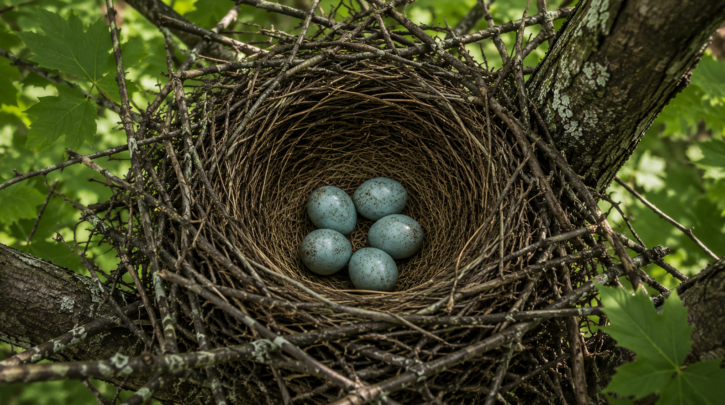

Blue Jay eggs are pale blue, greenish, or buff-colored, marked with brown or gray speckling — a moderate camouflage pattern suited to a nest that sits fully exposed in the open canopy rather than hidden inside a cavity.
Egg Color and Pattern
The speckling isn’t decorative. Because a Blue Jay nest has no walls or enclosure to hide it, egg camouflage does real work here that a cavity nester’s plain, unmarked eggs simply don’t need. The mottled pattern breaks up the eggs’ outline against the nest lining, offering some protection from visually hunting predators during the moments a parent is briefly off the nest.
Clutch Size
A typical clutch runs three to six eggs, with four or five being the most common count. Eggs are generally laid about one per day until the clutch is complete, timed to begin within a few days of the nest cup being finished.
Incubation
Incubation is handled primarily by the female, lasting roughly 16 to 18 days. The male feeds her throughout this period so she can stay on the nest consistently, and both parents cooperate closely on the surrounding nest duties. Because incubation doesn’t begin in earnest until the clutch is complete, chicks typically hatch within a day of each other rather than staggered over the full laying period.
Why Incubation Takes Longer Here
Longer incubation periods generally track with larger body size across birds, and Blue Jay’s incubation length fits this broader pattern — noticeably longer than a chickadee or finch, but still considerably shorter than the largest species.
Monitoring an Active Nest
Because the nest sits fully exposed, watching it from a respectful distance is possible in a way it isn’t with a cavity nest. That said, the aggressive nest defense Blue Jays covered in our nest guide — loud alarm calls and direct diving passes at anything that gets too close — makes getting near an active nest both unwise and unnecessary. Tracking parent visits from a distance is enough to confirm activity without risking a confrontation or stressing the birds.
Comparing Egg Appearance
Blue Jay’s moderately marked eggs sit between the plain, unmarked eggs typical of cavity nesters and the more heavily marked eggs of other open nesters, consistent with how exposed the nest actually is to visual predators.
Eggs about to hatch? See our guide to baby blue jays and fledging for what happens next, including an unusually extended apprenticeship period tied to this family’s intelligence.
How Egg Numbers Relate to Overall Reproductive Strategy
A moderate clutch of three to six eggs, combined with the extended parental investment covered in our baby blue jays guide, fits a broader pattern where a species invests more heavily per individual offspring rather than producing a larger number of young with less investment in each.
If an Egg Doesn’t Hatch
As with most songbirds, it isn’t unusual for one egg in a clutch to fail to hatch even when the rest of the brood develops normally. The moderate clutch size gives the pair some buffer against this kind of individual loss, though not an especially wide one.
What Comes Next
Once the clutch hatches, the real story of this species shifts from the eggs to what happens afterward — see our guide to baby Blue Jays and fledging for the extended post-fledging period that follows, one of the more distinctive parts of this family’s life cycle.