
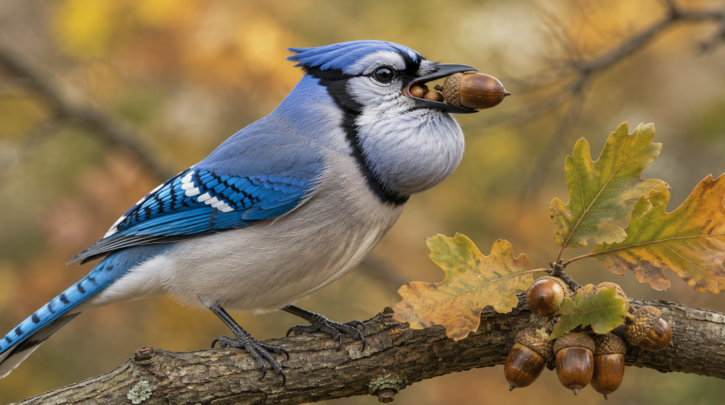

Blue Jays are genuine omnivores with one of the broadest diets — acorns and nuts dominate through fall and winter, insects take over during breeding season, and the popular reputation for raiding other birds’ nests turns out to be a much smaller part of the real picture than folklore suggests.
Acorns, Nuts, and Seeds: The Core of the Diet
Across the year, plant material makes up the large majority of a Blue Jay’s diet, with acorns and other nuts especially important through fall and winter. This ties directly into the caching behavior covered in our oak forest guide, where a single jay may cache thousands of acorns in a single season.
A Specialized Throat Pouch for Carrying Food
Blue Jays have an expandable pouch in the throat and esophagus that lets a single bird carry several acorns at once — up to around five in some observations — back to a cache site, rather than making a separate trip for each individual nut. This anatomical adaptation is central to how efficiently jays can move large quantities of food during peak caching season.
Insects During the Breeding Season
Insects and other invertebrates become considerably more important during spring and summer, particularly caterpillars, which play a major role in feeding chicks during the demanding nestling period.
Fruit and Berries
Wild and cultivated fruit rounds out the diet opportunistically, particularly in summer when berries are widely available. This is a minor but consistent component alongside the dominant nut, seed, and insect categories.
What About Other Birds’ Eggs and Nestlings?
Yes, this happens — but considerably less often than Blue Jay’s reputation suggests. Multiple stomach-content studies have found eggs and nestlings in only a small fraction of examined Blue Jay stomachs, with plant material making up roughly three-quarters of the diet across a typical year. See our full myth-busting guide for the actual data behind this widely exaggerated reputation.
Historic stomach-content studies consistently find that plant material makes up roughly three-quarters of a Blue Jay’s annual diet, with bird eggs and nestlings appearing in only a small fraction of samples examined.
Feeder Favorites
- Whole or shelled peanuts — a major favorite, easily cracked by the jay’s strong, robust bill
- Sunflower seed, particularly black oil sunflower
- Suet, taken readily alongside smaller backyard birds
- Corn and other larger seed types that smaller feeder birds generally can’t manage
Ready to set up a feeder that matches this diet? See our feeder setup guide for the sturdier designs a larger bird like this actually needs.
Occasional Small Vertebrate Prey
Blue Jays occasionally take small vertebrates opportunistically, though this makes up a genuinely minor share of the overall diet compared to the plant matter and insects that dominate most of the year.
How Diet Shifts Across the Year
Spring and summer bring a heavier reliance on insects and developing fruit, while fall and winter shift decisively toward nuts and cached food, mirroring the same general seasonal pattern seen in the chickadee and finch families, though on a considerably larger scale given how much more food a jay-sized bird actually needs.
Regional Diet Variation
Diet composition also varies by region depending on which native trees and shrubs are locally abundant — a Blue Jay in oak-dominated forest relies more heavily on acorns specifically, while populations in areas with more beech or hickory shift accordingly toward whichever nut crop is locally dominant.
Why Bill Strength Matters So Much for This Diet
A Blue Jay’s robust, straight bill is well suited to cracking hard-shelled nuts, a genuine structural requirement given how central nuts are to the overall diet compared to the finer, more delicate bills of smaller seed specialists.
A Diet Built Around Flexibility
Few backyard birds show quite this much dietary breadth — genuine omnivory across plant matter, insects, fruit, and occasional vertebrate prey, all handled by the same bird depending on what a given season happens to make most available.
What This Flexibility Means for Backyard Hosts
Because the diet is so broad, a Blue Jay feeding station doesn’t need to be nearly as precisely calibrated as a nyjer-focused finch setup or a suet-focused woodpecker station — peanuts alone go a long way, and nearly anything else offered gets at least opportunistic use on top of that from a genuinely curious, food-motivated visitor willing to try nearly anything once it looks even remotely edible on any given day of the week.