
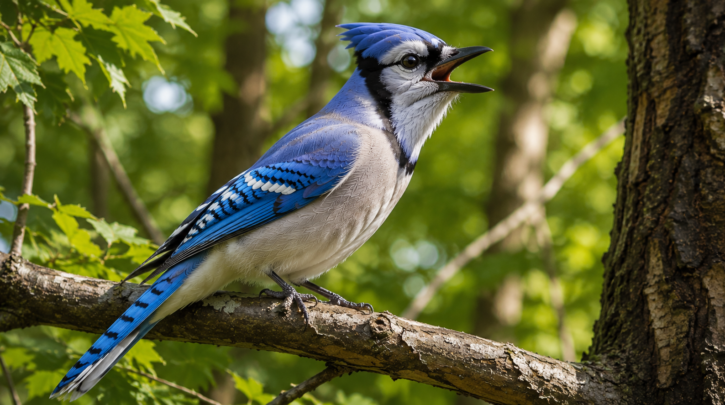

Beyond the harsh, unmistakable scream most people associate with Blue Jays, this species has a genuinely sophisticated vocal repertoire — including a well-documented ability to convincingly mimic hawk calls, a behavior that scientists still don’t fully agree on the purpose of.
The Signature Call
Blue Jay’s most familiar sound is a loud, harsh, repeated “jay-jay” scream, used as an alarm call and general territorial announcement. This call carries far and is often the first sign a jay is present before it’s actually spotted.
A Broader Repertoire
Beyond the signature scream, Blue Jays produce a range of softer sounds, including quiet rattles and clicks used in closer contact between mates or family members, quite different in tone from the loud alarm call most people know the species for.
Documented Hawk Mimicry
Blue Jays are well documented to accurately imitate the calls of hawks, particularly Red-shouldered Hawk, closely enough that the mimicked call can genuinely fool a human listener, and possibly other birds as well. Steller’s Jay shows similar hawk-mimicry ability.
Why Would a Jay Mimic a Hawk? The Debate
Several explanations have been proposed, and researchers haven’t settled on a single confirmed answer. One hypothesis is that mimicked hawk calls function as a genuine warning, alerting other birds to a real hawk in the area. Another is more strategic: a jay might use a fake hawk call to startle competing birds away from a feeder or food source, clearing access for itself. A third possibility is that the mimicry serves no specific adaptive function at all and simply reflects a broader corvid capacity for vocal imitation.
Blue Jays can convincingly imitate a hawk’s call — and scientists still don’t agree on whether it’s a warning system, a clever feeder tactic, or just a side effect of being an unusually vocal mimic.
Corvid Intelligence Behind the Behavior
This kind of vocal flexibility is consistent with the broader intelligence corvids are known for generally — the same family that includes crows and ravens, species well documented for problem-solving and tool use. Mimicry ability in jays is one visible expression of cognitive sophistication that’s harder to observe directly in day-to-day backyard behavior.
Distinguishing a Real Hawk From a Mimicking Jay
In practice, distinguishing a genuine hawk call from a jay’s imitation by ear alone is genuinely difficult, even for experienced birders. Visual confirmation — actually spotting the bird making the sound — remains the most reliable way to tell the two apart.
Other Vocal Mimicry in Jays
Blue Jays in captivity have been documented mimicking a range of other sounds beyond hawk calls, including other bird species and even some human-made sounds, reinforcing that this mimicry capacity extends well beyond a single specialized hawk-call imitation.
Curious what other cognitive feats this family is capable of? See our oak forest guide for the memory-driven caching behavior behind one of the more significant ecological stories in backyard birding.
How Researchers Study This Mimicry
Documenting hawk mimicry typically involves recording jay vocalizations in the field and comparing sound spectrograms against genuine hawk call recordings, allowing researchers to confirm just how close the acoustic match actually is rather than relying on subjective impression alone.
Does Every Jay Species Mimic Hawks?
Documented hawk mimicry is strongest in Blue Jay and Steller’s Jay, the two crested species most closely related to each other within the genus Cyanocitta. Less research exists on hawk mimicry specifically in California Scrub-Jay, Canada Jay, and Pinyon Jay, though corvids generally show at least some capacity for vocal imitation.
Recognizing Jay Calls in Your Own Yard
Learning to recognize the difference between a jay’s harsh alarm scream and its quieter rattles and contact calls builds a genuinely useful foundation for interpreting what’s happening in a yard, even before working through the added complexity of hawk mimicry.
A Call Worth Double-Checking
If a hawk call sounds suspiciously close and persistent without any actual hawk in view, checking for a jay perched nearby is a reasonable next step — especially if smaller birds at a feeder scattered briefly and then returned once the “hawk” call stopped, a pattern more consistent with a jay clearing the area than an actual predator passing through.
Final Thoughts
Few backyard birds reward close listening as much as jays do, given how much genuine ambiguity exists between their real alarm calls and their remarkably convincing mimicry of an entirely different, much larger bird of prey. The next suspicious hawk call worth a second look might turn out to be a jay all along.