
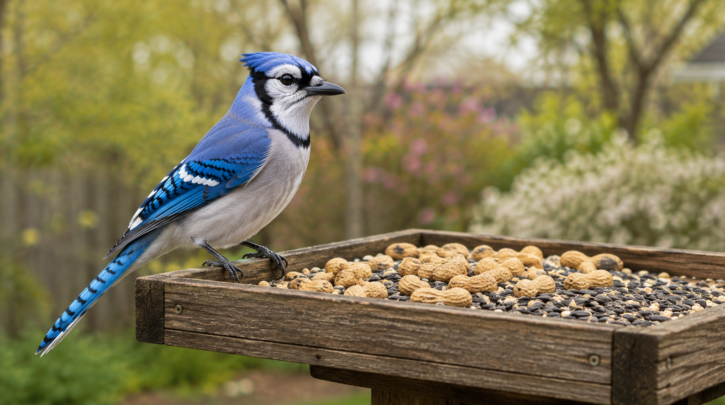

Blue Jays are considerably larger and bolder than most backyard feeder visitors, and a feeder setup built for finches or chickadees often simply doesn’t work for this species — different scale, different design priorities.
Why Standard Tube Feeders Often Fall Short
Many tube feeder ports and perches are sized for considerably smaller birds, leaving a jay unable to feed comfortably even if it’s genuinely interested in the food inside. Platform and tray feeders, or larger hopper designs, generally work far better for a bird this size.
Platform and Tray Feeders
An open platform or tray feeder gives a jay plenty of stable perching room and easy access to a range of larger food items — peanuts, corn, sunflower — without requiring the bird to squeeze into a small feeding port.
Peanut Feeders
A sturdy mesh feeder holding whole or shelled peanuts is one of the most effective ways to attract jays specifically, since peanuts are consistently one of this species’ strongest feeder preferences. Whole in-shell peanuts, in particular, give jays a chance to use their strong bill exactly the way they would on a wild acorn.
Suet
Jays take suet readily, generally sharing a standard suet cage without difficulty, though a particularly determined jay can sometimes empty a cage faster than a smaller bird would.
Ground Feeding
Jays are comfortable foraging directly on the ground, and will readily pick up seed dropped or kicked out of other feeders above, meaning some jay feeding happens passively even without a dedicated ground station.
Managing Feeder Dominance
Because jays are large, bold, and food-motivated, they can genuinely dominate a shared feeding station, discouraging smaller birds from feeding nearby while jays are present. Positioning a dedicated peanut feeder away from a main songbird feeding station is a practical way to satisfy jays without letting them monopolize the feeders meant for smaller visitors.
Want feeders that actively limit jay access to protect smaller-bird feeding stations? See our jay-proof feeder guide for designs built specifically around that goal.
Feeder Durability
Given how strong a jay’s bill is, feeders intended for this species benefit from sturdier construction than a typical finch or chickadee feeder would need, since repeated use by a larger, more forceful bird puts more wear on lightweight materials over time.
Capacity Considerations
Because jays are large birds with correspondingly larger appetites, a feeder built for this species benefits from meaningfully greater capacity than a typical songbird feeder, reducing how often refilling is needed once a family group or small local flock becomes a regular visitor.
Mounting and Placement
A sturdy pole or robust hanging mount matters more here than for lighter-weight feeders, since a jay’s weight and vigorous feeding style can stress a flimsy mounting setup considerably more than a chickadee or finch ever would.
Combining Feeder Types
A feeding station offering a peanut feeder, a platform tray, and a suet cage together covers the practical range of what jays actually seek out, while still leaving room for a separate, smaller-bird-focused station elsewhere in the yard if feeder dominance becomes a concern.
A Simple, Effective Starting Setup
For a first-time host, a single sturdy platform feeder stocked with whole peanuts covers most of what a jay actually wants, without requiring investment in multiple specialized feeder types before knowing how much local jay activity to actually expect.
When to Expand the Setup
Once local jay activity is confirmed and consistent, adding a suet cage and a secondary tray for corn or larger seed rounds out a more complete station, though this expansion is rarely necessary right from the very first day a feeder goes up.
Signs a Feeder Is Working Well
Regular, confident visits, peanuts disappearing at a steady pace, and eventually a family group rather than a single individual are all reasonable signs that a feeder setup is genuinely working as intended for this species.
A Simple Setup That Rarely Needs Much More
Most hosts find that a single well-stocked peanut feeder, checked and refilled regularly, satisfies local jay demand without needing the kind of elaborate multi-feeder setup that other species covered across this entire network sometimes require to see consistent, reliable activity.
Final Thoughts
A sturdy platform feeder stocked with peanuts remains the single highest-leverage purchase for attracting jays — everything else in this guide is secondary to getting that one piece of equipment right first. Add capacity and variety later, once local activity actually justifies expanding further.