
This may be the single most ecologically significant individual bird behavior — ecologists credit jays with helping entire oak forests spread across the continent after the last glaciation, simply by doing what comes naturally at acorn season.
The Problem: Acorns Can’t Fly
Unlike many tree seeds adapted for wind dispersal, acorns are heavy and drop essentially straight down from the parent tree. Left entirely to gravity, an oak population would spread extremely slowly, seedling by seedling, rarely moving more than a short distance from an existing tree in any given generation.
The Jay Solution: Long-Distance Caching
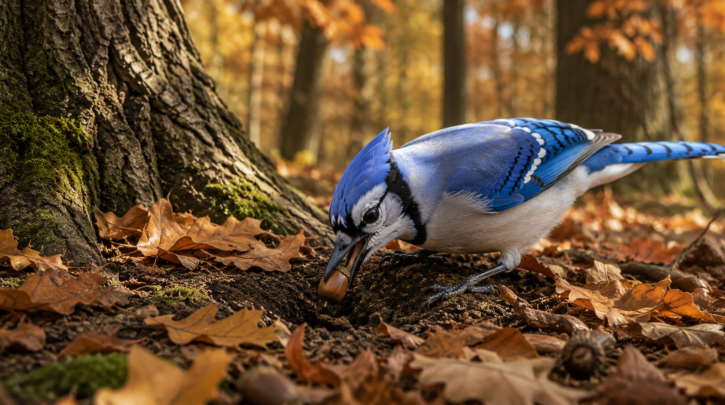
Blue Jays cache enormous numbers of acorns each fall — thousands per bird in some studies — carrying several at once in the specialized throat pouch covered in our diet guide, and burying them individually across a wide area. Documented caching flights have carried acorns over a mile from the source tree, distances gravity alone could never achieve.
Not Every Acorn Gets Retrieved
Because jays cache far more acorns than they ultimately need or manage to retrieve, a meaningful fraction remain buried in soil — exactly the conditions an acorn needs to germinate successfully. An uneaten, forgotten cache effectively becomes a planting.
Reid’s Paradox: A Real Scientific Puzzle
Paleoecologists have long grappled with what’s sometimes called Reid’s Paradox: the puzzle of how oak and other tree species recolonized northern latitudes so quickly after the last glacial retreat, apparently far faster than slow, gravity-based seed dispersal alone could explain.
Jays as a Proposed Solution
Ecologists studying this paradox have proposed jays and other scatter-hoarding animals, including squirrels, as a major mechanism explaining the surprisingly rapid postglacial spread of oak forests — each individual caching flight functioning as a small, repeated act of long-distance seed dispersal, multiplied across an enormous number of birds over an enormous number of years.
Ecologists studying how oak forests recolonized North America after the last glaciation have proposed jays as a key part of the answer — each acorn a jay caches and never retrieves is effectively a small act of forest expansion.
A Genuine Keystone Disperser
This role makes jays a genuine keystone species for oak-dominated ecosystems — not just a bird that happens to eat acorns, but an active participant in how oak forests establish, recover, and expand across a landscape over time.
Modern Relevance
Understanding this relationship matters well beyond historical curiosity. Restoration ecology projects working to reestablish oak-dominated habitat increasingly factor jay and other scatter-hoarder activity into how quickly and effectively a restored area might actually recolonize with oak, rather than assuming trees alone will spread on their own timeline.
Want to support this relationship directly? See our attracting guide for how retaining or planting oak trees connects your own yard to this genuinely significant ecological story.
A Fitting Legacy for a Backyard Bird
It’s a genuinely striking thought that the same bold, loud bird raiding a backyard peanut feeder is also, in a very real ecological sense, part of the reason oak forests exist across so much of the continent in the first place.
How Researchers Study This Relationship
Studying jay-driven acorn dispersal typically involves tagging or otherwise marking individual acorns, then tracking how far and in what direction jays actually carry them before caching, giving researchers concrete distance and pattern data rather than relying on inference alone.
Other Species That Contribute to This Pattern
Squirrels also cache acorns and contribute to oak dispersal, though generally over shorter distances than a flying jay can manage, making the two dispersers complementary rather than redundant — squirrels handling more local redistribution, jays handling the longer-range movement that actually lets oak populations expand into genuinely new territory.
A Behavior Worth Appreciating Every Fall
Watching a jay methodically working through a fall acorn crop, one throat-pouch load at a time, is a genuinely different experience once you understand what that behavior actually adds up to at a landscape scale over enough seasons and enough birds.
A Story Worth Sharing
Of all the ecological relationships, this may be the single most compelling one to share with someone unfamiliar with backyard birding — a common, loud, sometimes maligned feeder bird turns out to be genuinely responsible, in aggregate, for shaping the distribution of an entire tree family across a continent over thousands of years.
Final Thoughts
It’s a striking thought that the same bold, loud bird raiding a backyard peanut feeder is also, in a very real ecological sense, part of the reason oak forests exist across so much of the continent. Every acorn a jay caches and never retrieves is effectively a small act of forest expansion — repeated across an enormous number of birds over thousands of years, that adds up to a genuine, measurable role in how oak-dominated ecosystems established and spread after the last glaciation.
Few backyard bird facts carry this much ecological weight. The next time a jay works methodically through a fall acorn crop, one throat-pouch load at a time, it’s worth remembering what that ordinary-looking behavior actually adds up to at a landscape scale.