
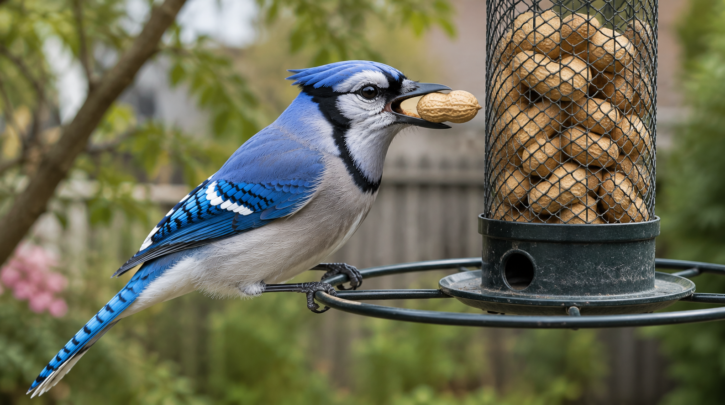

Attracting jays is genuinely straightforward — this is a bold, food-motivated, highly adaptable family that responds quickly to the right setup. The bigger consideration for many hosts is balancing jay access against the needs of smaller backyard birds sharing the same space.
Offer Peanuts and Nuts
Peanuts are the single most effective attractant covered in our feeder guide and peanut and nut feeder guide. Whole in-shell peanuts in particular give jays a satisfying food source that closely matches their natural acorn-cracking behavior.
Plant or Retain Oak Trees
Because acorns are such a central part of the natural diet, mature oak trees are one of the most valuable long-term additions a property can offer, doubling as both a major food source and, as covered in our oak forest guide, part of a genuinely significant ecological relationship.
Other Valuable Native Trees
- Oaks — acorns are a primary caching food
- Beech and hickory — other nut sources jays readily cache and eat
- Native berry-producing shrubs — a secondary food source through summer
Provide Water
Jays are enthusiastic bathers, and a sturdy birdbath sized for a larger bird — covered in our birdbath guide — is a genuinely effective addition beyond just feeder food.
Balancing Jay Access With Smaller Birds
Because jays can dominate a shared feeder, many hosts run two separate stations: a dedicated peanut feeder positioned some distance away to satisfy jays, and a separate feeder stocked with nyjer, smaller sunflower, or other food less appealing to jays for finches, chickadees, and similar smaller visitors.
Jay-Proof Feeders as an Alternative
For hosts who want smaller birds to have reliable access without needing two separate stations, a caged or otherwise size-restricted feeder design, covered in our jay-proof feeder guide, physically excludes a bird jay-sized while still allowing smaller species through.
Reduce Pesticide Use
Because insects play a real role in the diet during the breeding season specifically, minimizing pesticide use supports jays alongside most other backyard birds.
Setting Realistic Expectations
Given how bold and intelligent jays are, a well-stocked peanut feeder often draws attention within days rather than weeks, and a family group may quickly learn to treat a reliable yard as a regular stop on a larger daily foraging route.
Ready to put up your first feeder? Start with our peanut and nut feeder picks, then decide whether a second, jay-proof feeder makes sense for the smaller birds sharing your yard.
A Realistic Timeline
Because jays are bold and quick to investigate new food sources, results often come faster than with many other backyard birds — a well-stocked peanut feeder can attract attention within days, particularly if jays are already established somewhere nearby in the neighborhood.
Working With a Small Yard
Even a modest yard can attract jays with a single well-placed peanut feeder, though a larger property with mature oak or other nut-producing trees offers considerably more long-term value given how directly this family’s diet and caching behavior connects to nut-producing trees specifically.
Avoiding Common Mistakes
- Expecting a standard tube feeder to work well, when a platform or peanut-specific feeder generally performs far better
- Assuming hosting jays automatically endangers every other nesting bird nearby, rather than understanding the actual, more modest scale of nest predation risk
- Removing mature oak or nut-producing trees without considering the long-term food value they provide
- Placing a single feeder and expecting it to satisfy both jays and much smaller birds equally well
A Species Worth Hosting on Its Own Terms
Jays bring genuine personality, intelligence, and visual presence to a backyard, and recognizing them for what they actually are — bold, adaptable omnivores rather than nest-raiding villains — makes for a considerably more accurate and rewarding hosting relationship than the exaggerated reputation would otherwise suggest.
A Long-Term Relationship Worth Building
Given the lifespan and territory fidelity covered in our lifespan guide, a well-provisioned yard has a genuine chance of hosting the same jay family for many years running, making the initial setup effort a worthwhile long-term investment rather than a one-season novelty.
A Family Worth the Small Effort Required
Between the modest feeder investment, the long-term value of nut-producing trees, and the genuinely long lifespan covered elsewhere on this site, attracting jays offers an unusually favorable return relative to the effort actually required to get started.
Final Thoughts
FFew backyard birds respond as quickly, or as visibly, to a well-planned setup as jays do. A well-stocked peanut feeder often draws attention within days, and a family group can quickly learn to treat a reliable yard as a regular stop on its daily foraging route.
Recognizing jays for what they actually are — bold, adaptable omnivores rather than nest-raiding villains — makes for a considerably more accurate and rewarding hosting relationship than their exaggerated reputation would suggest. Given their genuine lifespan and territory fidelity, a well-provisioned yard has a real chance of hosting the same jay family for years, making the initial setup effort a worthwhile long-term investment rather than a one-season novelty.