
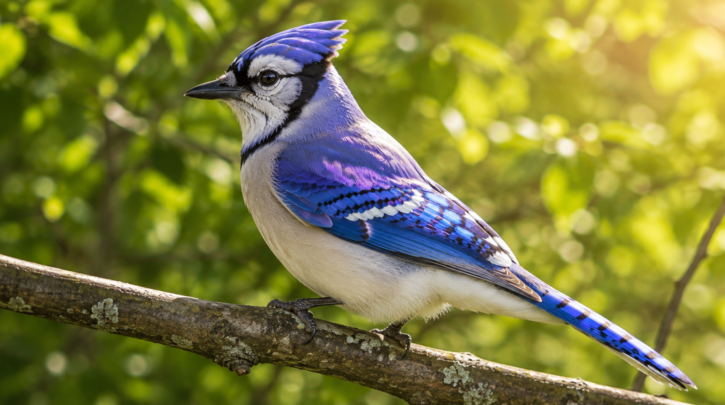

You don’t need binoculars to know a Blue Jay is in your yard. It’s loud before it lands, it’s bigger than almost everything else at the feeder, and its blue-white-black pattern isn’t subtle. So the usual binocular pitch — “get closer to birds you can barely see” — doesn’t really apply here. The honest case for glassing a jay is different, and once you understand what it actually is, it changes what you should be shopping for.
Do I really need binoculars for a bird this loud and obvious?
Not for identification, no. If the goal is just confirming “yes, that’s a Blue Jay,” your eyes already do that job at 30 feet. Where binoculars earn their place is everything ID doesn’t cover: the way the blue on a jay’s wings and tail isn’t a flat color but a shifting, almost metallic sheen depending on the angle of light; the crest going from relaxed and flat to sharply raised in the half-second before a jay reacts to something; the small social choreography at a busy feeder, where jays are constantly reading each other’s posture. None of that requires magnification to exist, but all of it is easy to miss at a glance and genuinely rewarding once you slow down and actually look.
What magnification actually helps with jays specifically?
Less than you’d think. Because jays are typically seen at close-to-mid range — a feeder ten feet from the window, a branch across the yard — high magnification is often a liability rather than an asset. Above about 8x, hand-shake becomes more noticeable at close range, and the field of view narrows enough that a jay hopping between branches can be genuinely hard to keep in frame. For a bird you’re mostly watching in your own yard, 7x to 8x magnification hits the sweet spot: enough detail to see feather structure and eye color clearly, without the shake and tunnel vision that comes with 10x or 12x glass pointed at something twenty feet away.
Why does color rendition matter more than zoom for jays?
Because the single most interesting thing about a Blue Jay’s appearance isn’t shape, it’s color — and specifically, color that changes. That blue isn’t pigment. It’s structural coloration: microscopic keratin structures in the feather barbs scatter light in a way that reads as blue to our eyes, which is why a crushed or backlit Blue Jay feather can look dull brown instead. This means the exact same bird can look flat slate-blue in overcast light and shift toward a brighter, almost violet-blue as it turns in direct sun — a real, physical effect, not a trick of the eye. Binoculars with high-quality glass and good coatings render that shift accurately; cheap glass tends to flatten it into a duller, more uniform blue that loses the effect entirely. If you only optimize one spec for jay-watching, optimize this one over raw magnification.
Will cheap binoculars ruin the experience?
Not ruin, but noticeably flatten it. Budget binoculars, especially with uncoated or single-coated lenses, tend to produce dimmer images with less contrast and a slight color cast, usually a warm yellow tint that mutes blues specifically — which is close to a worst-case scenario for a bird whose main visual appeal is its blue. You’ll still identify the jay fine. You just won’t see the structural color shift, the crisp white wing bars, or the subtle blue-gray gradient on the back nearly as well. For casual yard use, the jump from bargain-bin optics to a mid-range pair with fully multi-coated lenses is the single biggest quality improvement most people will notice, more than any jump in magnification or price beyond that point.
What’s actually happening with the crest, and can binoculars help me read it?
Yes, and this is one of the most underrated reasons to glass a jay up close. The crest isn’t decorative — it’s a real-time mood signal. Flattened low and smooth generally means a relaxed, feeding, or non-alert bird. Raised sharply and held tall usually signals alertness, agitation, or an aggressive posture, often right before a jay chases another bird off a feeder or reacts to a predator overhead — behavior covered in more depth in our guide to blue jay aggression. At a glance, without optics, you’ll catch the extremes — fully flat versus fully raised — but binoculars let you see the in-between positions and the speed of the change, which is often where the actual information is. A crest that snaps upright the instant a shadow crosses the yard tells you a hawk just passed over, often before you’d have noticed anything yourself. A stable, magnified view also makes it easier to confirm the finer field marks covered in our species identification guide — useful on the rarer occasion when what’s at the feeder turns out to be a look-alike rather than a Blue Jay at all.
How much should I actually spend for casual feeder-and-yard use?
For jay-watching specifically — short distances, decent light most of the time, casual rather than serious rarity-chasing use — you don’t need to spend at the level a dedicated field birder would for distant warblers in dense canopy. A solid mid-range pair, generally in the $120–$250 range, gets you fully multi-coated optics, a comfortable 7x or 8x magnification, and build quality that holds up to being picked up and set down constantly by a kitchen window. Spending more buys you marginal improvements in low-light performance and edge sharpness that matter far more for distant, dim-light birding than for a bright blue bird sitting on a feeder pole in daylight. This is a case where the species itself, not just the budget, argues for staying mid-range rather than chasing premium glass.
Do jays notice or react to someone watching them with binoculars?
Generally not more than they’d react to a person simply standing at a window or in the yard. Jays are alert, intelligent birds — a point covered in our guide to blue jay intelligence — and they do respond to sudden movement, unfamiliar shapes, or a person stepping outside, but a stationary observer with binoculars raised isn’t a meaningfully different stimulus than a stationary observer without them. If anything, watching from just inside a window or behind cover, rather than standing exposed in the open yard, keeps behavior more natural regardless of whether you’re using optics at all.
Beyond optics quality, what features actually matter for everyday use?
A short list of practical features matters more here than most binocular buying advice suggests, since this pair is likely living by a window or getting grabbed on the way outside rather than packed carefully for a birding trip. Rubber-armored housing survives the occasional bump or drop far better than an exposed metal or hard plastic body. A reasonably wide eye relief (15mm or more) matters if you wear glasses, since it determines whether you can see the full field of view without pressing the lenses uncomfortably close. Weight matters too — anything under about 22 ounces is comfortable to hold up for the minute or two of a typical feeder-watching session, while heavier pairs start to feel like a commitment rather than a quick grab. None of this replaces optical quality as the priority, but it’s the difference between a pair that gets used daily and one that ends up in a drawer.
Does this advice apply to watching other backyard birds too, or is it jay-specific?
The core principle — that close-range, well-lit, common backyard species benefit more from color rendition and comfort than from raw magnification — holds for most feeder regulars, not just jays. But jays are a particularly good test case for it, precisely because the payoff (that structural blue shift, the readable crest) is so visually obvious once you’re actually looking for it. If you’re building out a full feeder setup, our guide to attracting Blue Jays and feeders guide cover the rest of the setup this pair of binoculars is meant to complement.
Sources: Blue Jay structural coloration is documented by Audubon’s Blue Jay field guide and Cornell Lab’s All About Birds.