
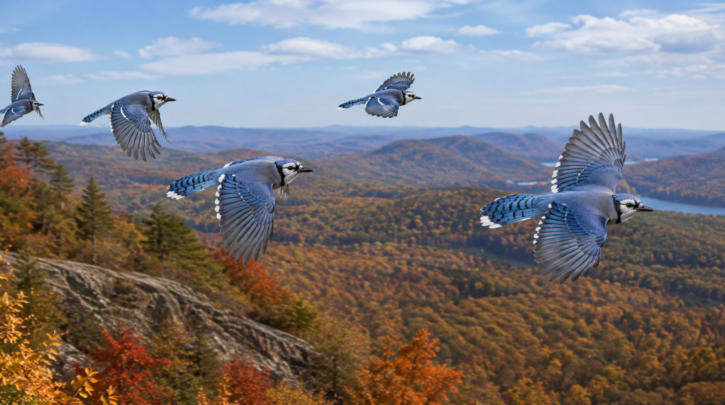

Blue Jay migration is one of the more genuinely puzzling questions — some individuals from a given population migrate south each fall, others from that same population stay put year-round, and researchers still don’t have a complete explanation for why.
A Partial, Individually Variable Pattern
Unlike a species with a clean, predictable resident-versus-migrant split by latitude, Blue Jay migration varies at the individual level in ways that aren’t fully explained by age, sex, or geography alone. Banding and tracking studies have found the same individual jay migrating in one year and remaining resident the next, suggesting the decision isn’t fixed for a given bird across its lifetime.
Daytime Migration: A Visible Exception
Most migratory songbirds travel at night, but jays that do migrate move during the day, often in loose flocks. This makes migrating Blue Jays a genuinely observable phenomenon — hawk watch sites along lakeshores and ridgelines regularly report notable Blue Jay flight counts during fall migration season, sometimes in the thousands at a single well-positioned observation point.
Why This Remains Genuinely Unresolved
Proposed explanations include local food availability, individual body condition, and even social factors within a given year’s population, but no single explanation has been confirmed as the primary driver. This is a rare case in backyard bird biology where the honest answer is that scientists are still working it out.
Steller’s Jay, California Scrub-Jay, and Canada Jay: Largely Resident
These three species are considerably more straightforwardly resident, staying in the same general territory year-round across most of their range, similar to the resident pattern seen on the woodpecker and chickadee.
Pinyon Jay: A Nomadic, Irruption-Like Pattern
Pinyon Jay shows a genuinely different pattern — nomadic movement tied to pinyon pine seed crop success, broadly comparable to the irruptive movement seen in Pine Siskin and Common Redpoll on the finch, though driven by a single specific tree species rather than a broader boreal seed crop.
Canada Jay: An Early-Nesting Cold Specialist
Canada Jay’s non-migratory lifestyle comes with a genuinely remarkable trait of its own: it’s among the earliest-nesting birds in North America, beginning incubation in late winter while temperatures remain well below freezing, relying on dense insulating feathers and an insulated nest structure to keep eggs viable.
Curious about the ecological behavior tied most closely to Blue Jay specifically? See our oak forest guide for one of the more significant individual bird behaviors.
A Family Showing Nearly Every Pattern at Once
Between an unresolved partial migrant, three straightforward residents, a nomadic pine-seed specialist, and an early-nesting cold specialist, jays manage to touch on nearly every migration strategy of backyard birds, all within one closely related family of birds.
How to Recognize Migrating Blue Jays
Watching for loose daytime flocks moving in a consistent direction along a ridgeline or lakeshore during fall is the most reliable way to actually observe this migration in progress, since it happens visibly rather than at night the way most songbird migration does.
Why This Genuinely Matters for Backyard Hosts
Understanding that Blue Jay migration is individually variable helps explain why a feeder might see a noticeable drop in jay activity some falls and barely any change in others, even without any change to the feeder itself or anything else in the yard.
A Reminder About Scientific Honesty
Not every question in backyard bird biology has a settled answer, and Blue Jay migration is a genuinely good example — the honest response is that researchers are still working out exactly what determines which individuals migrate in a given year.
A Question Worth Revisiting Over Time
As tracking technology improves and longer-term individual data accumulates, this may be one area where the picture genuinely clarifies over the coming years, making Blue Jay migration a reasonable topic to keep revisiting rather than treating as a permanently closed question with a fixed, unchanging answer.
Final Thoughts
Migration in this family turns out to resist easy summary, a fitting reflection of just how individually variable and genuinely complex jay behavior can be across even a single closely related family.
That same individual variability, more than any single fixed migratory rule, may be the closest thing to a genuine unifying theme across this particular, still-open, and genuinely fascinating scientific question worth revisiting, year after year, as new tracking data continues coming in from ongoing banding, satellite tagging, and citizen-science observation studies conducted widely and consistently across all of North America.