
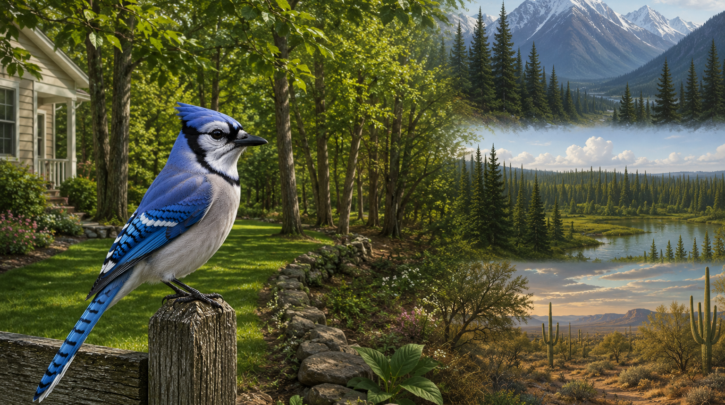

Between the five species covered on this site, jays occupy an enormous range of North American habitat — from suburban deciduous forest to boreal taiga to high desert pinyon woodland.
Blue Jay
Found across eastern and central North America in deciduous and mixed forest, forest edges, and suburban and urban parks and yards. Blue Jay tolerates human-altered landscapes better than almost any other species on this list, and some range expansion westward has been documented over the past century as the species adapts to changing landscape and feeder availability.
Steller’s Jay
Found in coniferous mountain forest across the West, from Alaska down through California and the Rockies, including campgrounds and suburban communities within its mountain range.
California Scrub-Jay
Found in Pacific coast oak woodland, chaparral, and scrub, and extremely common in suburban yards across much of California and the Pacific Northwest.
Canada Jay
Restricted to boreal and taiga forest across Canada and Alaska, extending into some northern US mountain ranges including the Rockies, Cascades, and Adirondacks. This is the most cold-adapted species on this list, discussed further in our migration guide.
Pinyon Jay
Tied closely to pinyon-juniper woodland across the Great Basin and Southwest, with a diet and range shaped almost entirely around pinyon pine seed availability.
A Family Spanning Nearly Every Forest Type
Taken together, these five species cover an extraordinary range of habitat within one family — suburban deciduous forest, coastal oak woodland, coniferous mountains, boreal taiga, and high desert pinyon woodland all host at least one common jay species.
Why Blue Jay Adapts So Well to People
Blue Jay’s comfort around human development is widely attributed to its genuine dietary and behavioral flexibility, covered in our diet guide, combined with the general cognitive flexibility corvids are known for — a combination that lets the species exploit bird feeders, ornamental nut trees, and altered landscapes about as readily as it uses natural forest.
Curious whether any of these species travel seasonally, or stay put year-round? See our migration guide for a genuinely unresolved piece of ongoing science.
Overlap Zones
Steller’s Jay and Pinyon Jay overlap across parts of the interior West, generally separated by habitat rather than a hard geographic boundary. Blue Jay and Steller’s Jay meet only in a narrow zone through the Great Plains, where genuine range overlap remains considerably less studied than in some other bird families.
Elevation as a Habitat Factor
Steller’s Jay and Pinyon Jay both extend into different elevation bands across the same general western region, with Steller’s Jay favoring denser, higher-elevation coniferous forest and Pinyon Jay sticking to lower, more open pinyon-juniper woodland — a real elevation-based separation even in areas where both species’ broader ranges technically overlap.
Urban and Suburban Tolerance Varies by Species
Blue Jay and California Scrub-Jay both tolerate dense suburban development well, often becoming among the most familiar birds in a yard. Steller’s Jay adapts reasonably well to mountain communities and campgrounds within its range, while Canada Jay and Pinyon Jay generally require more substantial natural habitat and are less likely to become regular visitors in heavily developed areas.
A Family Worth Watching Across Regions
Because this family spans such an unusually wide range of habitat types, traveling to a genuinely different region can introduce an entirely different jay species than what’s typical at home, making jays one of the more rewarding families to encounter while traveling within North America.
What Habitat Availability Means for Long-Term Planning
Because so much of this family’s distribution ties directly to specific tree types — oaks for Blue Jay and California Scrub-Jay, conifers for Steller’s Jay and Canada Jay, pinyon pine for Pinyon Jay — habitat planning for jays really comes down to planning around the right trees for a given region rather than any generic feeder-based strategy alone, however well stocked that feeder might otherwise be.
Final Thoughts
Range and habitat alone explain a great deal about which of these five species to expect in a given yard, well before plumage or feeder choice even enters the picture for most backyard hosts.
Combining range with even a rough sense of local forest type — deciduous, coniferous, or pinyon-juniper — narrows the identification question down to one, or at most two, realistic candidates in nearly every part of North America, well before any closer plumage comparison across two or more similar-looking species is even genuinely needed at all. Range alone, in other words, does most of the identification work before a single field mark ever needs checking.