
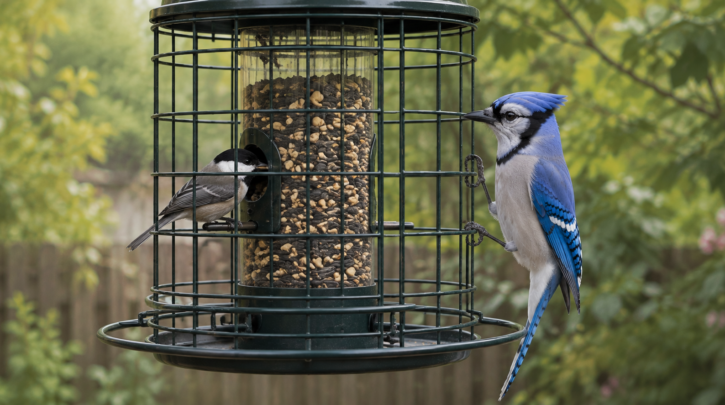

Not every host wants jays at every feeder — and given how easily this bold, food-motivated family can dominate a shared feeding station, a genuinely size-restrictive feeder design is often the most practical solution.
What We Looked For
- An outer cage or mesh barrier sized to exclude a jay-sized bird specifically
- Continued full access for chickadees, finches, and nuthatches
- Durable construction able to resist a jay repeatedly attempting to force its way in
- Straightforward cleaning and refilling despite the added outer structure
Duncraft Caged Bird Feeders
A protective outer cage surrounds the actual feeding ports, physically blocking a bird as large as a jay while leaving smaller species, including chickadees, finches, and nuthatches, free to pass through the cage and feed normally. This design directly addresses the feeder-dominance issue covered in our feeder guide.
Duncraft Squirrel Blocker Bird Feeder
Though marketed primarily against squirrels, this mesh design has a documented side effect worth noting for jay exclusion specifically: user reports confirm that larger birds including starlings, doves, and pigeons also can’t access seed through the fine stainless mesh, suggesting a similarly sized bird like a jay would face the same restriction.
Why Size-Based Exclusion Works So Well Here
Because jays are considerably larger than chickadees, finches, or nuthatches, a cage or mesh barrier sized correctly for the smaller species creates a genuinely reliable physical barrier rather than a partial deterrent, unlike weight-based mechanisms that depend on a specific threshold a determined bird might occasionally work around.
Running Both Feeder Types Together
Most hosts who want to feed both jays and smaller birds run a jay-proof feeder alongside a separate, unrestricted peanut feeder positioned some distance away, covered in our peanut and nut feeder guide — satisfying jays at one station while guaranteeing smaller birds reliable access at another.
Ready to set up the jay-friendly side of this arrangement too? See our peanut and nut feeder guide for feeders built specifically to attract jays rather than exclude them.
A Reasonable Expectation
Even a well-designed jay-proof feeder won’t stop jays from investigating it occasionally — the goal is reliable physical exclusion from actually accessing the food inside, not preventing curiosity or repeated attempts.
Testing Effectiveness in Your Own Yard
Local jay behavior can vary somewhat, so watching how a specific feeder actually performs over the first few weeks — whether jays give up quickly or keep testing the barrier persistently — offers a more reliable read on real-world effectiveness than any general product description alone.
Combining Exclusion With Distraction
Pairing a jay-proof feeder with a separate, unrestricted peanut station elsewhere in the yard tends to work better than exclusion alone, since a jay with an easy, reliable food source nearby has less incentive to keep testing a barrier it can’t get through anyway.
A Worthwhile Investment for Mixed Households
For any yard hosting both jays and smaller feeder birds, a genuinely effective jay-proof design solves a real, common frustration — watching chickadees and finches get repeatedly displaced by a larger, bolder visitor — more reliably than behavioral deterrents or feeder placement tricks alone ever could.
A Reasonable Long-Term Setup
Once established, a two-station approach — one jay-proof feeder protecting smaller birds, one open peanut feeder satisfying jays — tends to require minimal ongoing adjustment, settling into a stable routine that both groups of birds learn to rely on over time.
Signs the Setup Is Working
Consistent, undisturbed activity from chickadees and finches at the protected feeder, alongside regular jay visits at the separate peanut station, is a reasonable sign that a two-feeder approach is genuinely accomplishing its goal.
Considering the Full Cost-Benefit
A jay-proof feeder costs somewhat more upfront than a basic open feeder, but for a household genuinely frustrated by jays monopolizing feeder access, the ongoing improvement in smaller-bird activity generally justifies that initial expense well within the very first season of regular use.
Final Thoughts
A genuinely effective jay-proof feeder solves a real, common frustration — watching chickadees and finches get displaced the moment a jay arrives — more reliably than any feeder-placement trick alone. Most hosts find the modest upfront cost pays for itself within the first season of undisturbed feeding for smaller birds.
Pairing a jay-proof feeder with a separate, unrestricted peanut station elsewhere in the yard works better than exclusion alone: a jay with an easy food source nearby has little incentive to keep testing a barrier it can’t get through anyway.