
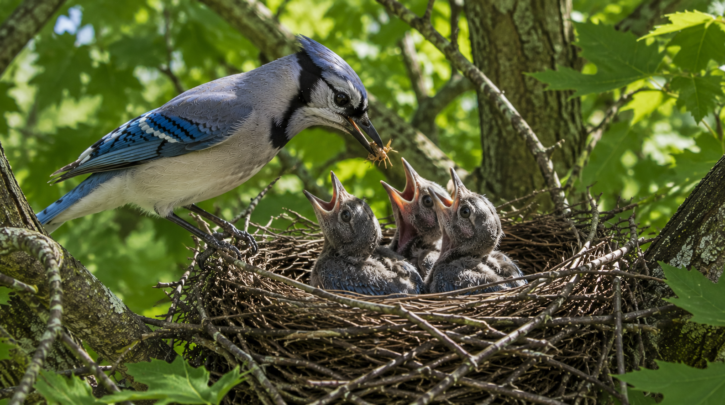

Summer covers the full arc of a typical Blue Jay nesting attempt — incubation, an insect-heavy feeding push, fledging, and the start of a genuinely extended apprenticeship that continues well past the point most backyard birds achieve independence.
Incubation and Hatching
The female incubates primarily on her own for roughly 16 to 18 days, as covered in our eggs guide, while the male feeds her throughout this period.
Feeding the Brood
Both parents feed chicks heavily on insects early on, gradually introducing more of the varied diet covered in our diet guide as chicks grow. Loud, persistent begging calls are often the clearest sign of an actively growing brood nearby.
Fledging
Chicks typically fledge roughly 17 to 21 days after hatching, but this is far from the end of parental involvement — see our baby blue jays guide for the extended post-fledging period that follows, tied to this family’s genuine cognitive complexity.
Family Groups Take Shape
By mid-to-late summer, it’s common to see a family group of one or two adults with several young jays moving and foraging together, a visible unit that will persist well into fall in many cases.
A Single Brood, Generally
Most Blue Jay pairs raise only one brood per season, focusing available energy on the extended post-fledging investment described in our fledging guide rather than attempting a second nesting effort.
Cooperative Species in Summer
For jay species that rely on cooperative breeding, covered in our cooperative breeding guide, summer is when helpers from previous broods are most actively assisting with feeding and defense, a genuinely different social dynamic than the simple pair structure most backyard hosts will actually observe.
Want to support a family group through this demanding season? See our attracting guide for the food and habitat that matter most right now.
Water Needs in Summer Heat
Hot summer weather makes a reliable water source more valuable than usual, both for adults and for parents making frequent feeding trips, and a sturdy birdbath covered in our birdbath guide benefits the whole family group through the hottest stretches of the season.
Monitoring an Active Brood From a Distance
Because Blue Jay nests are open rather than hidden inside a cavity, tracking progress through summer generally means watching feeding-visit frequency and listening for begging calls from a respectful distance, given the aggressive defense covered in our nest guide.
A Season That Tests Habitat Quality Directly
Few stretches of the jay year make insect availability and overall habitat quality this visible — a territory genuinely rich in insect life will show it clearly in how successfully a brood is fed and fledged compared to a territory that looks similar on the surface but offers less actual food.
A Season Best Watched Patiently
Between incubation, feeding, and fledging, summer moves through several distinct phases fairly quickly, rewarding a host who checks in regularly rather than expecting one single dramatic moment to mark the whole season’s progress.
A Family Group Worth Following
Once fledglings join a family group, following that group’s movements through the rest of summer offers a genuinely engaging window into the early stages of the extended apprenticeship covered in our baby blue jays guide, well before it becomes fully visible later in fall.
A Season of Rapid Change
Compared to the quieter pace of winter or the ecologically loaded activity of fall, summer moves quickly — a nest that was just eggs a few weeks earlier can already hold fledged, flying young by the time summer winds down, a genuinely fast transformation to witness firsthand if watched consistently.
Comparing Summer to Other Species
A jay’s summer, with its shared parental effort and quick transition to an extended family-group apprenticeship, contrasts with the more strictly female-led incubation and shorter independence period seen in several other species.
Final Thoughts
Summer is short but genuinely eventful, compressing incubation, feeding, and the start of a months-long apprenticeship into just a few genuinely intense weeks scattered across each and every single year this remarkable species returns to nest and raise young.
Blink at the wrong moment during summer, and an entire nesting cycle can genuinely pass by almost unnoticed — a real reason to check in on a known nest site more than once a week during this particular, genuinely eventful season of the year for any pair actively raising young somewhere reasonably close and genuinely nearby during that particular, quite specific breeding season of the given year in question.