
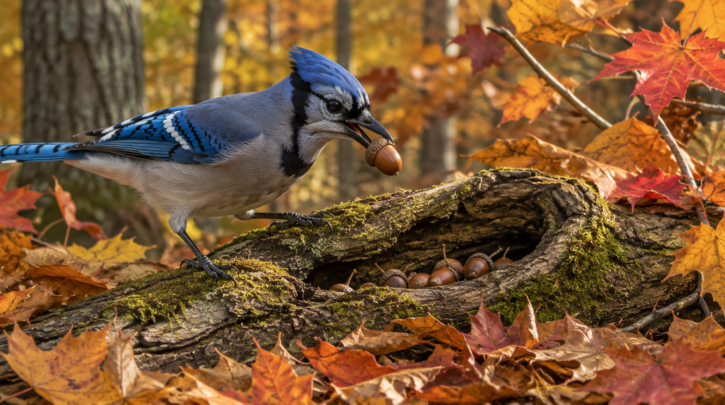

Fall is the single most ecologically significant season of the Blue Jay year — this is when the acorn-caching behavior covered in our oak forest guide actually happens, at a scale that genuinely shapes forest composition over the long run.
Peak Caching Season
Jays spend fall methodically working through the local acorn crop, carrying several nuts at a time in the specialized throat pouch covered in our diet guide and burying them individually, sometimes over a mile from the source tree.
Visible Daytime Migration
For the subset of Blue Jays that do migrate, fall is when this happens — visibly, during the day, in loose flocks that hawk watch sites sometimes report in large numbers. See our migration guide for why this remains only partially understood.
Family Groups Begin Loosening
The family groups that formed over summer, covered in our summer guide, gradually loosen through fall as young birds become more independent, though it’s still common to see family members traveling together well into the season.
Pinyon Jay: Nomadic Movement Tied to Cone Crop
Fall is also when Pinyon Jay’s nomadic, irruption-like movement, covered in our migration guide, becomes most apparent, with flocks shifting considerable distances depending on how the local pinyon pine cone crop actually turned out.
Post-Breeding Molt
The molt begun in late summer typically completes during fall, leaving adults in fresh plumage heading into winter, proceeding without the time pressure a true long-distance migrant would face.
A Good Time to Support Caching Directly
Retaining mature oak and other nut-producing trees, covered in our attracting guide, matters most during exactly this stretch of the year, when jays are actively working through whatever nut crop is locally available.
Curious what winter looks like once caching season wraps up? See our winter guide for how all that cached food actually gets used.
A Season Worth Watching Closely
Understanding what’s actually happening during a jay’s fall caching runs turns a routine feeder visit into something considerably more interesting — a small, repeated contribution to a genuinely significant ecological process playing out one acorn at a time.
A Good Time for Habitat Assessment
With breeding activity fully wrapped up, fall is a reasonable time to assess whether existing nut-producing trees on a property are genuinely supporting local caching activity, and to consider whether any additional plantings might be worth adding before the following fall’s acorn crop.
Comparing Fall to other Backyard Species
Fall looks meaningfully different depending on which species a host is watching — an oriole host’s fall centers on frantic pre-migration fueling before a complete seasonal absence, while a jay host’s fall is defined by a genuinely consequential ecological behavior that’s easy to overlook without knowing what to actually watch for.
A Season That Rewards Patience
Watching a jay work steadily through a fall acorn crop over several weeks, rather than expecting a single dramatic event, offers the most complete picture of just how much caching activity a single bird can genuinely accomplish across one season.
A Season That Connects Directly to Next Year
Every acorn cached and forgotten this fall is a small step toward next year’s potential oak seedlings, making this season a genuinely direct link between one year’s jay population and the forest structure of decades to come.
A Season Shared With Squirrels and Other Cachers
Jays aren’t the only species busy caching through fall — squirrels contribute meaningfully to the same general process, generally over shorter distances, making fall a season of overlapping, complementary dispersal effort across several different backyard species at once.
Recognizing Peak Caching Activity
A jay making repeated, purposeful trips between a specific tree and various nearby locations, rather than lingering to eat in place, is a reliable sign of active caching behavior rather than ordinary feeding behavior at a feeder or natural food source.
Final Thoughts
Fall rewards a host who knows what to look for, turning an otherwise ordinary bird visit into a small window onto one of the more genuinely significant ecological stories in all of backyard birding, playing out quietly in plain sight the whole time, whether or not any single human observer actually notices it happening at all.
Taking even five minutes to watch a jay work through a fall acorn crop offers a genuinely rare, direct glimpse into an ecological process most people walking right past a jay at that exact moment would never think to actually stop, pause, and take even the smallest bit of extra time needed to look for themselves closely enough.